Category Archives: Uncategorized

Building Microphones

It wasn’t that long ago that the idea of building your own microphones was fine for a science fair project, but the end result wasn’t anything with a practical use. There are a few old articles about building microphones floating about the web. Take a look at The Bantam Velocity Microphone by L.J. Anderson and L.M. Wiginton, (Thanks to New York Dave at Prodigy Pro for posting this) Make This Ribbon Mic by M.H.O. Hoddinot, A Professional Condenser Microphone by R.Williamson,( originally published in AUDIO magazine, July, 1963)  A Stereo Condenser by Debenham, Robbinson, and Stebbings (image HERE) but the information is generally sparse, and it requires precision machining facilities. One person has even built his own gold vapor vacuum deposition chamber for gold-sputtering diaphragms. But with the rise of Chinese manufacturing and the resulting flood of Chinese-built microphones on the market, building a useable microphone is now a more realistic proposition. We can let the Chinese factories take care of the specialized machining, while we provide quality electronics, tuning, and care in assembly to end up with… possibly… a superior microphone, or at least one that’s custom-tailored.

Now, I don’t normally advocate buying Chinese audio gear. Quality control is often lacking, raw materials are questionable to poor, and the lifespan can be short as cheap components fail. And I dislike the idea of buying a look-alike product– i.e., a Chinese copy of a Schoeps or Neumann microphone. But there’s an opportunity here, if one looks at an inexpensive import mic as a source of raw materials. Others have realized this, and built successful small businesses by sourcing Chinese components, then tweaking the parts to yield some really nice results.

Don’t think for a moment that any mic that you or I will build will sound as good as, say, a mic by Neumann, Schoeps, DPA, etc. These mics will never replace those pieces of gear, and when you compare them side-by-side, the deficiencies of a lower-cost product will stand out like a sore thumb. But these mics are still useful, and depending on the situation, can even be a better choice than a top-grade mic. (For example, in an environment where a mic might get destroyed… wild flailing drummers, motocross races, mud wrestling, monsoon rainforests, etc.)

I’ve always been fascinated by the engineering that goes into microphones. It’s a combination of machining to almost unbelievable precision coupled with electronics circuitry that is, to my simple mind at least, almost magic that it works at all. Then when you get to hear the results of a REALLY  nice mic (say, a DPA or Neumann) in front of a good musician… the experience is unforgettable.

The only problem is the price, which is also unforgettable.  The pair of DPA 4016s I heard at the first Nashville AES Recording Workshop sounded absolutely beautiful… a truly AMAZING sound. The list price for the pair is over $3,800. In Brian Gilbert dollars, that price may as well be 38 million… in other words, until I can directly make $4k with that particular piece of gear, it’s an extravagant expense, no matter how much I love the sound. I’ve got a family to feed, after all.

So until I can afford a selection of really classic mics, I can experiment with making or modifying cheaper versions. While I’ll never expect to duplicate the sonic ability of a mic costing $1,900, perhaps there are some things I can do with a less expensive mic that can improve the sound a little.  And it turns out that I’m not alone. The MicBuilders forum (micbuilders@yahoogroups.com) has a lot of people who are interested in the same sort of experimentation. I don’t often contribute, as most of the folks there are far more advanced than I am. But the people there are very generous with their time and willingness to help others learn. Similar audio experimenters can be found at ProdigyPro.

Generally, mic builders have two options: A) buy a readily-available mic and modify, or B) source the parts and build from scratch.

The Neumann MA-200 mic capsule

Some parts, such as the capsule, can be hard to find, but they are out there. Capsules can be found on e-bay, or they are available from Peluso. Microphone bodies require precision machine-shop work if they’re going to look at all professional.

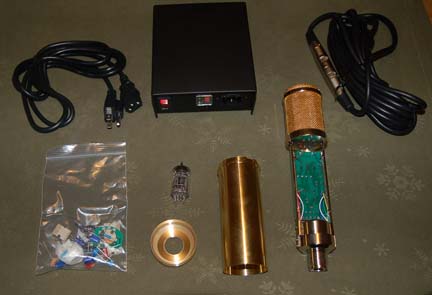
There is a third option that I recently discovered. A company called Aurycle sells condenser mic kits, along with a few completed mics. The prices for Aurycle kits are very affordable… lower than the sum of the parts if you bought them individually. I have built three of their microphones… two large-diaphragm FET mics, and a large-diaphram tube mic. Overall, I’m quite pleased with their products and the results, but like everything in life, there are pros and cons. Let’s start with the PROS:

  • The prices are affordable… downright cheap in fact.

    The Aurycle A460 FET mic frame and body

  • Entire kit is less than the cost of the parts alone.
  • Easy to substitute different components to see how they sound.
  • Modifications are easier, since it comes disassembled.
  • Transformer-based design lets you try a transformerless circuit easier than the other way around.
  • The low cost encourages experimentation. If I screw the pooch, I won’t loose too much sleep over it.
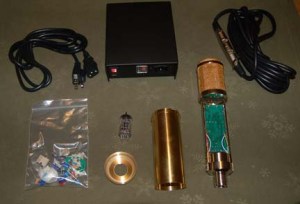
    Aurycle A5500 Tube mic kit as supplied. The high-voltage power supply comes assembled.

  • While these ARE NOT good first projects, they are great learning tools for teaching yourself about microphone electronics and developing skills.
  • The machining is pretty good, with all-brass bodies that are suitably heavy.

Now the CONS:
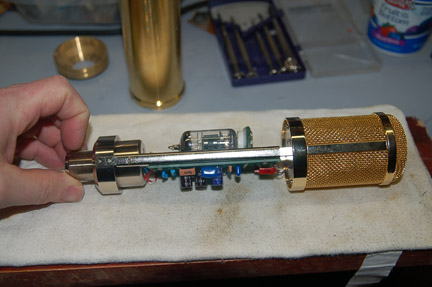
The completed 5500 tube mic.


  • The end result of the stock build is very typical of, and in some cases identical to, other low-cost Chinese mics.
  • Documentation is not nearly as good as it should be. In some cases, it’s incomplete… you’ll need to do some internet research in order to complete the microphone.
  • Electronic components are adequate, but rather low in quality… typical Chinese stuff. This is an easy upgrade, though.
  • The brightly-polished brasswork as supplied has a slightly cheesy look to it, and the brass itself seems pretty low grade. Again, fairly easy (though potentially expensive) to change if you want.
  • These don’t come with any sort of clips, suspension mounts or cases, which you’ll need. Clips don’t always fit… I bought some that won’t work because the threads are too short.

Microphone building certainly isn’t for everyone, but it is an option for those who want to dig a little deeper into microphones and how they work. The sonic character of these isn’t likely to change your life… just another crayon for your box… but it’s certainly fun to use a mic that you built yourself. Otherwise, contact me… I have several custom-built mics for sale.

Frontline and DSLR Production Workflows

I recently got “the call…” Frontline was going to be taping in Nashville and was looking for audio support. After confirming that my wife Karen would be in town, I jumped on the gig like an Aussie jumps on a Fosters. I’m a huge fan of the show, and have been watching it for many years. It’s about the only news-related program left that I trust anymore, as their reporting standards and production values are just about the best in the business.

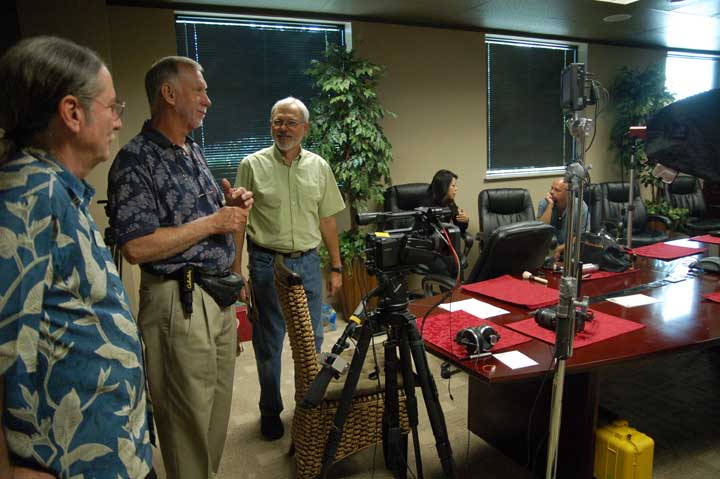
Caitlin McNally, Sam Russell and Dallas Jackson interviewing for Frontline

I worked with Caitlin McNally and Sam Russell, both from Ark Media in NYC, a production company that supplies several Frontline documentaries. We shot on Wed, Dec 8th, at Rivals.com, a media office in Nashville, TN, that specializes in high school football… the subject for the documentary, scheduled to air in April of 2011. Our primary subject was Dallas Jackson, a senior analyst and radio host at Rivals.com

What surprised me about this shoot was that it was to be shot on a Canon 7D. I generally dislike DSLR video production. The images are truly beautiful, especially when the camera is in experienced hands with a good variety of lenses. But no matter how you slice it, a DSLR is still consumer equipment, and it’s stuffed full of compromises- especially from an audio standpoint. Everything from tiny, unreliable connectors, no  ability to monitor the audio or video, no timecode, no outputs, no controls, lousy camera balance… these are all factors that distract the crew. And every moment spent fussing with connectors is a moment that you aren’t concentrating on what you’re shooting.

But Sam has a good bit of experience on DSLR shoots, and I learned a bit about how they can work better from an audio standpoint. The first thing he did was forget feeding my audio to the camera, instead using the on-camera mic to record a reference track only. I think he did anyway All production audio was to be recorded in my bag, on my little Zoom H4n. Sam had an identical unit that he uses on location. Shooting is easier when your camera isn’t tethered to the mixer, but slates are critical. We would usually slate at the head of a cut, but the scenes would often go beyond the 12-minute limit of the camera (another compromise). When that happened, we’d both stop down (the H4n doesn’t actually burn a file until you press stop) and do a tail slate. One of the things I’ve identified a real need for is a very small one-handed clapper slate, as using the full-size one was sometimes a bit tricky with one hand. I’m designing one now. (UPDATE 12/13/10… ) I’ve finished a prototype, and it works great. I’ll probably build a second, slightly more refined version and post a photo, as my prediction is that these little things would be essential for a short-staffed DSLR shoot.

Another cool trick was Sam’s DSLR balance rig. I neglected to get a photo, but it was pretty neat. A homemade affair, it was just a board about 2 x 2 x 30. At one end was a tripod plate for the camera, at the other end was about 5 lbs of weight. On the bottom, Sam screwed a piece of flat steel bent into an upside down ‘U’ shape, padded with foam and wrapped with tape. The whole affair rode on his shoulder like a normal camera would, but the counterweight allowed him to keep the camera in front of him for long periods of time. He could even momentarily take both hands off the camera and it wouldn’t go anywhere.

Sam Russell's DSLR support rig

Harrison’s MixBus Nominated for TEC Award

As you probably know, I don’t particularly care for mixing on a computer. But I’m a realist, and I’ll be the first to admit that it is nice to have much of the capability of my old recording studio sitting in my laptop.

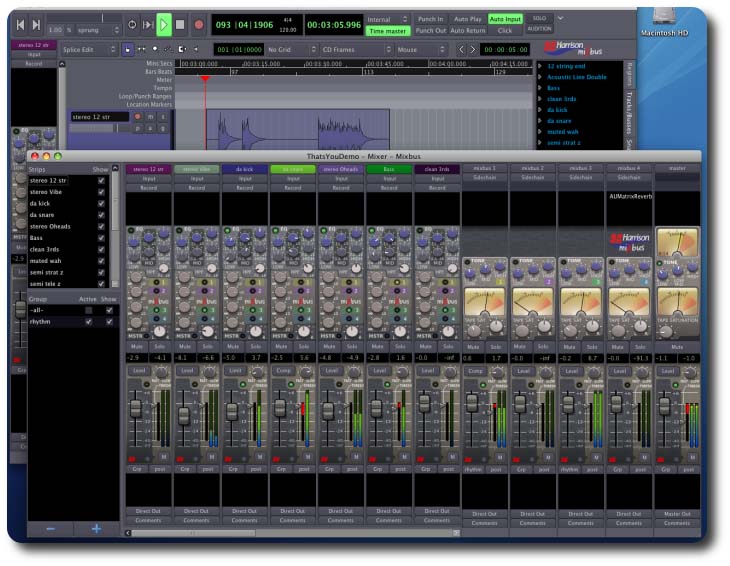
I’m also a particular fan on the Harrison MixBus DAW. It’s the closest thing available to working “old school” that I’ve been able to find, it’s flexible, VERY powerful, intuitive to use, and sounds great. And since everybody else uses ProTools, it gives me a bit of a competitive edge… plus it’s a little bit harder for someone to steal my settings.

Harrison MixBus screenshot

That’s why I was pleased to see that MixBus has been nominated for a TEC award this year. Anyone who is professionally involved in the audio industry is eligible to vote. Registration is free, you can vote online here.

*Full disclosure… I’m not connected to Harrison in any way, other than I like using their gear.

For Music-Producer Types… Notes From MixNashville

I attended MixNashville earlier this year, held at SoundCheck Nashville, a giant warehouse/practice/tour support facility. (an amazing feat in itself, since the facility was completely submerged by flooding earlier this year.) It was a pretty good show, though I do wish they had scheduled more lectures geared towards music business and studio survival, and fewer “How to Mic an X” or “Anatomy of a Mix” lectures. The reason might be that few people have any answers to the studio survival question.

An exception was a lecture given by Jay Frank. He’s the author of FutureHit.DNA, which is a book I’d never heard of until the conference. I’ve just started reading it, and at first glance it looks like it should be required reading for anyone involved in the music business.

I took a bunch of notes during the lecture, which I’ve typed up for this post. If you never deal with music on a professional production basis, then you’ll probably find little of interest here, but as a sometime studio engineer and producer, I found his comments to be really enlightening. Enjoy…

(NOTE: My apologies to Mr. Frank if I’ve misquoted him or gotten something wrong in these notes… I was scribbling as fast as I could… for the authoritative version, get the book. It’s only $16 at Amazon)

ANATOMY OF A FUTURE HIT

Lecture by Jay Frank, author of Future Hit DNA

Presented at Mix Nashville, Tuesday, Sept 14th, 2010

The “radio paradigm” doesn’t work anymore, i.e., people don’t use the radio to find new music to go out and buy. People used to stumble upon a song via radio or TV.

You have seven seconds to impress the listener. Research has shown that people form an opinion, positive or negative, within that time frame.

Old songs from the 1950s had 10 second intros. This was space for DJs to intro the song… a short instrumental music bed, if you will.

During the period of radio consolidation, computers began selecting songs. Longer intros resulted in more selection. This was accidental, as it was just for the DJs to use that space for selling cars, but it illustrates the role of technology in creating #1 hits.

In 2000, average intros went from 15 seconds to 8 seconds. In Jan-June of that year, the top downloads had an average intro of 6 seconds. There are some exceptions to this rule.

Currently there are far too many choices in new music. How do you cut through all the clutter? If you can get a listener to hang on through the first 10 seconds, they are much more likely to stay. So you lengthen the song & own the listening experience… say, from 3:45 to 4:30. If your listener spends more time with your song, they are spending less with the competition. Also, longer songs are cheaper to stream using current models.

Pandora pays the same rate regardless of length.They’ve also started 4 minute programming, no punk or oldies. (4 minutes of commercials per hour of music) In general, songs are too short. Longer songs are more cost effective.(1) Live 365 is a different deal. Payment will change within the next five years to payment for length of songs, i.e., more $$$ for longer songs. (2)

The only way for artists and music producers to make money is via multiple listens or purchase. If this is the case, then multiple versions- acoustic version, hard rock version, etc… make sense.

Example- Seelo song F*ck You. The first video had just lyrics on screen. 2 weeks later, actual video is released. Had 100K downloads.

Second example- Bed Intruder. Auto-Tune the News Went viral. (3)

There are 3 points in a song where people tune out… the beginning, middle, and the end. We’ve discussed the beginning. The MIDDLE, say, 2 mins in, at the end of the second chorus… if the song doesn’t change, or somehow shift, people will tune out.

The END… Nowadays, people get “stuck” on a song that is unresolved- like an abrupt ending. Like a good hook, it becomes an itch the listener can’t scratch. Only 10% of the top downloads offer a fade. Most leave you hanging.

For more on this subject, read “This Is Your Brain On Music” by Daniel J. Levitin. Very dense reading, but very informative.

We are in a singles world. Listening is done by playlist w/ shuffle. Albums are a holdover from industry delivery models. Labels should release more songs… almost no sales are resulting from back catalog.

For a beginning artist, it’s important to release singles more often. Keep feeding your fan base. There is a band called Pretty Lights– all songs are given away free on the internet. The band sold out RedRocks.

Daily Online Updates- constant updates on your website for producers, artists, engineers is essential. You have to keep giving people a reason to talk and think about you. If you can get a thousand fans to spend $100 a year on your band, then you can make a living. Half the labels are using this philosophy in their A&R meetings.

Radio Play- Publishers want 3-31/2 minute songs for radio play. Make a radio edit, but make sure the long version is the upload version.

Marketing Strategies- Use music videos wherever possible.

A side note… the way producers and fans look at music is often backwards. The PRODUCER considers first artist’s talent, then lifestyle, which results in the song. The LISTENER experiences the song first, then looks at lifestyle, then talent of the artist.

Cover songs are a great way to introduce yourself to fans.

Book FUTURE HIT DNA

(1)  Pandora aiming to loosen radio’s grip on drive time, 12 October, 2010 12:56:00, http://www.rbr.com/radio/28218.html

(2) Spotloads, Perception, And Listener Tolerance MONDAY, MARCH 22, 2010, http://www.radio-info.com/new-media/the-future-is-now/spotloads-perception-and-listener-tolerance

Meeting Cory Booker

One of the reasons I love my work is that I occasionally get to meet some fairly famous folks. Normally, this is just a brief exchange of pleasantries… not like we’re best buds, hangin’ out with a beer or anything. But still, it’s kinda fun.

This week I was fortunate enough to be called for a 2-day job with Dave Porfiri of Mindflow Media to record the Benwood Foundation lecture series. The speakers are some really big names in politics, academia, etc. Last month, I got to meet author Malcolm Gladwell. In the ’08-’09 series, I met environmental justice advocate Majora Carter (that lecture can be seen here) This month, it was Cory Booker, Mayor of Newark, NJ.

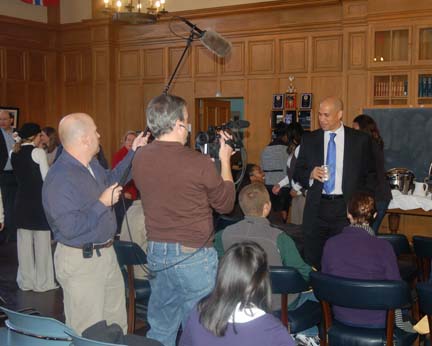
Dave and me shooting Cory Booker at the University of Tennessee at Chattanooga's Flag Room, Nov 19th, 2010. Photo by Lon Jordan.

Mayor Booker’s story is very well told in the documentary Street Fight, which was nominated for an Academy Award, but lost to March Of The Penguins. Mayor Booker is a vegetarian, but he allows himself one exception… PENGUIN MEAT! (“Tastes like chicken,” he claims.)

Mayor Booker at UTC

Mayor Booker at UTC breakfast Q&A session with students. Photo by Lon Jordan

Mayor Booker is an inspirational speaker. He’s certainly a politician, but seems a long way from your typical politician, since the major issues he faces in his city… guns, gang violence, drugs, poverty… can rarely be framed as “Democrat” or “Republican” problems. And he’s gotten results… something like a 40% reduction in shootings since taking office.

But probably what’s gotten the most attention was his defense of Newark on YouTube, where he “officially” put Conan O’Brien on the Newark Airport’s “no-fly list” (the Newark airport doesn’t have a no-fly list, but that’s really beside the point.) for a joke Conan made about Newark on his show.  “Try JFK, buddy!” If nothing else, it shows his sense of humor and his skill at using new media to get out his message. (the “feud” continued for quite awhile.)

It was an enjoyable shoot with good results, and I’ll certainly be watching Mayor Booker’s political career more closely in the future.

Classic Audio Products VP26 Mic Preamp

One of my recent projects on the bench is a pair of mic preamps by Classic Audio Products of Illinois.  I can’t say enough good things about this company. They are providing parts, circuit bards, and instruction that make top-quality builds of classic audio circuits available to people who are passionate about sound.

I had started with their 2520 discrete opamp kit, described in a previous post. These mic preamps are the end use of those opamps. I’ve put off building these for awhile to save up the cash, but finally bit the bullet and bought most of the parts to complete a pair. They aren’t finished yet… I still have a few more parts to buy, and I’m deciding whether to fabricate my own faceplates or use theirs. But I’ve competed enough of the build to give at least a preliminary report.

A pair of VP26 mic preamps at my bench. Still have transformers, pots, and switches to add.

For me, building one of these is not a casual proposition. I’m not a component-level engineer, and the risk that I could somehow screw this up is very real. But if there’s one thing that defines this company, it’s quality. Everything they supply is top-grade.

For example, let’s start with the documentation. The VP26 assembly manual can be downloaded here, and it’s clear that Jeff spent a lot of time to make this as clear as possible. With a project like this, clarity is important… there are plenty of opportunities to botch any electronics circuit (even more so when I’m holding the soldering iron), and the extra photos, instructions, and advice help to ensure that you aren’t likely to end up with a non-functioning preamp.

The circuit is an all-discrete update of a classic mic preamp circuit that has been optimized for contemporary parts. I’ve often studied old circuitry, only to find that they use obsolete and unobtainable parts, and I lack the ability to re-design for modern components. Jeff Steiger, who owns a 1976 API 3232 console, founded Classic Audio Products after years of experience maintaining and tinkering with his own console.

The components used in this circuit are the other side of the quality coin. There are no shortcuts in this design. The circuit boards have nickel-plated holes… this means the they take up solder for better connections with less exposure to heat for the part. Pots are all Clariostat sealed conductive plastic, and a glance through any Mouser or DigiKey catalog will show you that these things ain’t cheap. They should last for decades. The design uses Nichicon electrolytics, which are widely regarded among the DIY community. And the transformers are custom-wound by Ed Anderson to be as close as possible to the original equipment used by API.

This company should be appreciated by everyone in the professional audio field. In this day and age, it’s all too common to find gear that’s cheaply made by overseas copycat suppliers, and this is the antithesis of the “cheap is good” mindset. These things AREN’T cheap… each kit comes out at a hair under $200. But if I went out and bough all the components from individual suppliers, it would likely cost more. Their profit margins must be pretty slim indeed, and I believe that a big part of their business plan is a passion for quality audio. I want to support that whenever I can, and the best way to support them is to buy their stuff.

I’m very much looking forward to completing these units, even though I won’t be using them much for live production. What I need to do now is beg and plead the folks at Classic Audio Products to design an EQ or compressor circuit board and/or kit that uses the 2520 op amp, so I can build some more!

Using The Sennheiser 415t

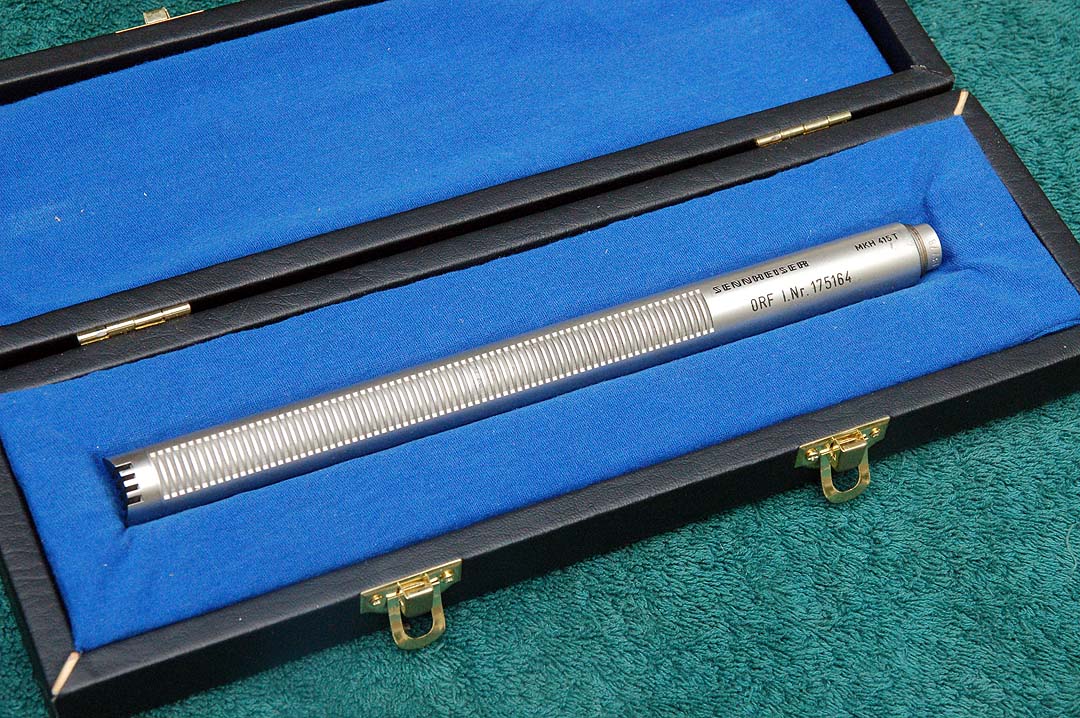
I recently got the chance to break out my old Sennheiser MKH415T. This jewel of a mic doesn’t get used a lot because its high-impedance circuitry is very sensitive to humidity and doesn’t do well with rough handling. It was a favorite among film crews back when it was new. The “T” refers to its power requirements, meaning 12-volt T power, sometimes called AB power. T power is less popular because it has a greater potential to damage microphones… if you plug a dynamic mic into a T-powered input, it can burn out the capsule, where 48 volt phantom generally won’t harm your mic unless the wiring is faulty. (Still, it’s good practice to plug in the mic first, THEN turn on the phantom power.) But T-power excels in battery-powered gear, with generally longer operating times and simpler circuitry.

My 415T. It came without a box, so this one is a copy. These should always be kept in a case and carefully handled.

My mic was formerly owned by the The Office de Radiodiffusion-Télévision Française,  as it’s engraved ORTF. The ORTF was the French equivalent of PBS. Mine came without a case, so I copied the construction of the case from my 815t and built a box that is a close copy to the factory original. My 415 is fitted with a Tuchel screw-on connector, so I had to build a short Tuchel to XLR adapter. It needed minor repairs as well… one of the tuning chokes would shift whenever the mic was moved from side to side. This was repaired with a small lob of beeswax to secure the choke. (the original Sennheiser service manual can be seen here)

Tuchel connectors are smaller than standard XLR connectors, and are secured with a threaded ring. They’re more secure and protect the contacts better, but more expensive and harder to find.

At one point, I compared the sound from the 415t to my more-often-used Sennheiser ME66/k6. The only way to do this is to set up both side-by-side and switch between the two. The ME66 sounds good, but the 415 sounds better. It’s hard to describe, of course… the differences are subtle. But it’s most noticeable in the top end, which is definitely smoother.

These microphones are often available on the web. There were two variants – the 415T and the 415T-U, the difference being Tuchel or XLR. The 3-pin Tuchel connectors can still be found, but it’ll take some hunting… I bought mine from Mouser, if I remember correctly. Accessories for these mics used the “MZ” prefix… Sennheiser MZA15 (Tuchel) or MZA15-U (XLR)  is an in-line battery-powered T supply, it’d be very handy if you could find one. MZF15 is a 6bD roll-off filter @25Hz. MZA56P-U would be a real prize… this converts from phantom power to 12vT.

The 415T undressed. Tolerances are very tight. Don’t adjust the chokes without proper test equipment, as you’ll most likely degrade the performance significantly. I repaired mine with a very tiny spot of beeswax, which secured the loose choke cores while maintaining adjustability.

In the real world, my 415T doesn’t get quite as much use as I’d like, since it needs kid gloves. It’s pointless to use it on a noisy set, or outdoors unless we’re shooting in Arizona… the Tennessee humidity is generally on the high side. But when conditions are right, it’s a fantastic peace of old gear that gives great results.

Sound Devices 442 Mixer

For a long time now I’ve been saving up for a new mixer. I recently bought a used PSC Alphamix from Trew Audio, but it was doing some weird stuff when it was first powered up (one channel appeared to be -6dB down at the output for about 20 minutes, and then it “fixed itself…”) I can’t take a chance of that happening on the set, so I returned it to Trew. Unfortunately, I discovered that the Alphamix is no longer being made, so a new unit was out.

When I was in Nashville for the Mix Nashville conference, I stopped  by Trew Audio to talk about my options. Rob Milner suggested a Sound Devices 442.

The Sound Devices 442 has a very high build quality and a number of useful controls and features.

Sound Devices has a reputation in the industry for building some of the best equipment in the business, and this mixer has a number of features that make it a valuable and flexible tool. Of course, being able to mix four audio sources via an over-the-shoulder bag is handy, even though most mixing jobs are admirably covered by my trusty Shure FP33. And though I’ve owned a Shure 4-channel mixer (the FP42) for awhile, the 442 is really a different beast altogether.

The output side of the mixer. The battery tube has a badly-designed spring on the positive end that can short out rechargeables.

The primary reason this mixer was purchased is direct outputs on each channel…  in addition to sending a mixed signal out, I can also record each individual input on my R4Pro 4-track recorder.  I normally record audio for film directly into the R4 or mixed straight to camera, but with the 442, I can record four iso channels on the R4 while mixing to camera at the same time.

The build quality on all Sound Devices equipment that I’ve used has been stellar, but every Achillies has his heel. On this mixer, it’s the battery tube. It’s not correctly designed, with a spring at the POSITIVE end of the tube. All other battery holders have a spring at the NEGATIVE end. With some rechargeable battery types, this spring can short the battery to its case, burning up the battery and leaving the mixer useless. Even though  the manual says you can use rechargeables in this mixer,  I NEVER use rechargeables with anything Sound Devices makes! I know from experience, it happened to me with a brand-new MM1 preamp (that uses the same type of AA battery tube holder. At first, they wanted to charge me $100 for a repair. Eventually, they fixed it without charge, but it was a surprising and disappointing customer support experience. Even though I vowed not to buy Sound Devices after that, there really aren’t any other options that have direct output capability. I’m avoiding the battery tube altogether by using an NP-1 battery cup with a custom-built cable and case to power the mixer. Standard alkalines go in the tube as a backup for the main battery. (look for a how-to-make-it post on these subjects later.)

The big reason I bought this mixer are those four little TA-3 connectors on the right. These direct outs can go to the Edirol R4Pro input, allowing four tracks of isolated audio to be recorded while mixing to camera AND a 2-track backup recorder!

The 442 has been discontinued in favor of the 552, which features a built-in 2-channel flash recorder. A number of the 442s can be found on the used market. I bought mine from Trew Audio in Nashville, and I highly recommend them as a supplier.

I’ve used this mixer on several shoots now, and I really like it. the LED metering is daylight-visible, and just about every parameter can be adjusted to suit my particular workflow. It’s a big improvement to my gear list.

Recent Shoots

I’ve done several shoots for clients recently… a political spot for Zach Wamp andAtomic Films (he lost), a medical piece for Canon Medical Imaging with DP Ted Meirs and Director Dwight Adair, and a short film for local producer/director Chris Clark.

Shooting for Canon Medical Imaging with director Dwight Adair, DP Ted Miers, and grip Wallace Braud

These three jobs couldn’t have been more different. The political spot was shot with the Red camera, the Canon production was shot with a Sony HDV camera, and Chris’ film was shot on a DSLR. The sound was different as well. The first two were single-person on camera, no two shots or complex dialog arrangements. These were shot with shotgun mics only and sent directly to the camera– no mixing necessary.

The film shoot required “double system” audio, recorded using an Edirol R4Pro(see my previous post on DSLR Audio).

DSLR Audio

DSLR films present a unique challenge in terms of audio. The ability of the Canon 5d to record HD video in a number of frame rates has launched a revolution in filmmaking. I believe the 5d was the first camera to implement HD video in a way that was professionally viable. (If you’ve never seen the video from a 5d, have a look here… but notice that there’s NO sync sound.) Other cameras can do this now as well, but the 5d still holds a lead in the DSLR filmmaking arena.

The images from these cameras are beautiful,

My audio cart for DSLR production features the R4 and Lectrosonics wireless receivers.

but recording audio was definitely an afterthought at the Canon factory. Early versions of the Canon 5d software offered little more than audio on or off, with no way to defeat the automatic gain control. There were some hacks available, and the new firmware is much better in terms of recording, but this is still an area that requires a dedicated location sound person. The best way to handle audio with a DSLR is doing it “old school.” You use a slate (or clapper) at the head of every scene, and record the audio to a second dedicated recorder. Sound is still captured using the camera’s onboard mic, but this is just a reference track. The resulting files are synchronized manually in Final Cut Pro. (though there are some neat software solutions for this job, such as PluralEyes automatic sync software.)

For Chris’ film, I used my Edirol R4Pro 4-track field recorder. Track 1 was generally reserved for the shotgun mic, while tracks 2-4 were used to record wireless lav mics on the talent, with the occasional plant mic hidden on the set to grab SFX or dialog. The lavs always suffer from the occasional clothing rustle, but having each one on a separate track enables you to mute out offensive noises or wireless hits on the individual channel. Having several audio sources to choose from in post opens up other creative options as well, such as stereo placement and 5.1 surround mixing.

Key grip Glenn Stegall (SamauraiHammer) doubled as my boom operator for some of Chris' short film.

I haven’t gotten the chance to do any of the editing yet with Chris, but I’m looking forward to hearing the footage and playing around with the post production files. This is an area that I’m slowly expanding into here, and I’m setting up a Final Cut Pro postproduction workflow here.

Discrete Operational Amps

The API 2520 discrete op-amp

Op-amps have been an important part of audio electronics for a long time. I remember reading as a kid about the “new” 741 types, and how op-amps would reduce electronic design to little more than building blocks. Than never exactly happened with audio circuits, but they did pretty much alter the landscape, and you’d be hard-pressed for find anything electronic in your studio that doesn’t use them.

The Melcor 1731 op-amp… somewhat rare

The “operational” part of op-amps refers to the inputs. There are two, an inverting and a non-inverting input. By taking some of the amp’s output and looping it around to one of the inputs, the amp can be made to do all sorts of handy things.

The venerable 709 opamp

There were some folks who realized early on that conventional op-amps required circuitry compromises, and that they could build their own operational amplifiers out of discrete parts (transistors, resistors, capacitors, and diodes) that better suited their needs, and outperformed the 309s and 741s that were available back in the day. The Jensen 990 and the API 2520 come to mind. There may have been others, but these two are the only ones that I can recall that have a long record of commercial availability and good performance. (Both companies are still producing audio equipment, and have a reputation for very high-quality, great sounding gear) These were used in a number of very high-end desks at a time when most desks were custom-built. Op-Amps for audio circuits have improved very dramatically since the days of the 741, of course, but there are still cases where discrete op-amps work very well.

So how do I get one of these little buggers? If you could find an affordable one used somewhere, you’d be extremely lucky… an API 2520 sold for $133 on eBay recently, and I saw no Jensens or Melcors. But there are some alternatives. My favorite is a tiny circuit board offered by

Four DOA2520 discrete op-amps… two have been completed, and two are about halfway done.

Classic Audio Products of Illinois. It’s an API2520 clone using available parts… some of these old circuits call for germanium transistors, which are impossible to find. I ordered one of the full kits ($17.50) and a few bare circuit boards ($2.30 each… a bargain).

Assembling these is not for the beginner or the faint of heart… they are very small, so that the finished op-amp has the same pin spacing and footprint as the original. Fortunately, these are very high-quality little boards. The holes are through-plated, so they take up solder very nicely. But they are so tiny that you need to be very careful when placing the parts to be certain that the right leads are going in the right holes. I have a stereo dissection microscope that I use to solder these boards… some sort of strong magnifier is necessary. Fortunately the boards come with a downloadable PDF instruction manual that guides you through the placement of the parts.

The circuit boards, like the originals, are pretty tiny.

Tip one is to use a pin jig to solder the pins. This is just a small block of wood with holes drilled in it to hold the pins straight while they are being soldered. I held the board over the block still with a spring clamp, and marked the location of each pin with a large needle. The needle pricks were drilled with a drill press. Now I place the pins in the holes, then place the board on top of the pins and solder from the top. Since the holes are through-plated, this works nicely, ensuring parallel pins. The pins on my first op-amp are a little wonky because I soldered it before I made my little wooden block pin jig.

Tip two is to solder the large transistors Q7 and Q8 just after soldering the pins, rather than following the recommended stuffing order. There are some nearby resistors that can be too tight to these transistors. By placing them first you can position the resistors in their holes with a little better fit. This is only cosmetic, but you may as well have these look nice. It goes without saying that you’ll need a good iron with a very fine tip.

A good stereo microscope isn’t a requirement, but it helps. Some kind of magnifier will be required to solder these.

I haven’t placed these in any equipment yet… just like the op-amps themselves, the preamps that use them are quite expensive. But just like the op-amps, there are kits and circuit boards available, and I’ll get started on some of these when time permits.

For the truly adventureous, you can roll your own from scratch. The circuit board for the Melcor DOA  can be seen here. Discussions about these and other discrete operational amps can be read on the Gearslutz forum, a fantastic resource for old studio gear lovers, and several folks have successfully reproduced classic circuits. Some of the difficulties include finding “unobtanium,” a favorite word of mine meaning electronic parts that are no longer manufactured, with no modern replacements. (germanium transistors, for example).

Update: Here are some other discrete op amp links:

  1. http://www.passdiy.com/pdf/diyopamp.pdf– a great article about discrete op amp design from Nelson Pass.
  2. http://www.forsselltech.com/downloads/design_discussions/JFET%20Opamp.PDF Fred Forssell’s article, “A Simple Class A JFET Operational Amplifier.”
  3. http://www.forsselltech.com/media/attachments/Class_A_JFet_Opamp.PDF Another op amp schematic from Fred Forssell
  4. http://www.johnhardyco.com/pdf/990.pdf John Hardy’s article, “990 Discrete Op Amp.” Several circuits here, including mic, phono, tape head preamps, a summing amp, and the MPC-1 preamp.
  5. http://www.diyrecordingequipment.com/directory/ Several discrete op amp designs are reviewed in the Project Directory. Click on “Other Gear” and you’ll see a heading for “Discrete OpAmps.”
  6. http://seniordesign.engr.uidaho.edu/2004_2005/tucson/Files/Final%20Report.pdf High Voltage, High Slew Rate Op Amp Design from Apex Microtechnology (Warning- high math hazard, may cause brain lock.)
  7. http://www.eisenaudio.com/diy500/tables/opamps/ Eisen Audio’s Discrete Op Amp page, has a large number of photos and descriptions of many opamps for the API 500 series circuits.
  8. http://www.sg-acoustics.ch/analogue_audio/discrete_opamps/index.html Samuel Groner’s discrete op amp page

Vinyl Transfer Station

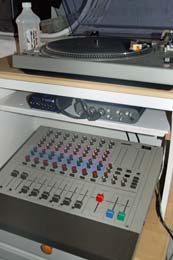
I’m in the process of moving my office downstairs, and now that I’ll have a little more space, I’m able to set up a small dedicated workspace for dubs and vinyl transfers. Right now, t consists of a Audio Technica turntable with an AT-400 cartridge, Sony MXP-29 mixer, and a new M-Audio Fast Track Pro interface. Not shown is the new LaCie 320GB triple interface hard drive that I’ll need to store all this data that I’m generating.

While I’m not a huge fan of the MP3 standard, there’s no denying it’s become pretty universal. And it is handy to have just about every record I’ve ever liked on a single ipod. Since I can leave this stuff hooked up, it’s much easier to do a vinyl to MP3 transfer now, though it’s still a fairly time-consuming process.

My dedicated vinyl transfer, dubbing, and encoding station.

Here’s a photo. The MXP-29 has a dedicated pair of inputs with phono preamps, so I’m able to go directly into the mixer. The Sony preamps are pretty accurate, if not a little sterile, but I think they sound a hair better than the small block-type preamp that I had been using. I monitor through a pair of AKG271 headphones, though I’ll occasionally listen to my Sony 7806 headphones. The AKGs are much more accurate overall, but the 7806s are more comfortable to wear and have a bass boost that sometimes makes a nice change. The turntable is a fairly nice Audio Technica that was donated by my brother-in-law. Fortunately the stylus and cartridge are still good… I’ve seen prices of $36 for a stylus. Last time I bought one, it was $2.59.

The records are recorded straight into Adobe Soundbooth with minimal processing. (See my previous post on Adobe Soundbooth.) While I can edit out all the crackles and thumps between songs, I usually leave them in for nostalgia’s sake. Occasionally a record will have a loud pop in a track… Soundbooth lets you highlight just the fraction of a second where the pop occurs, and then treat that section only, leaving the rest of the program untouched… A nice feature. While there are extensive EQ possibilities, I generally leave them alone unless I really want to play around.

Some of my newly acquired vinyl titles include Dark Side Of The Moon, and a near-mint pressing of Introducing The Beatles. Also picked up some Joni Mitchell, English Beat, and Candy-O by the Cars. My 14-yr old son wants to get some Queen as well… I force him to listen to some of these records as part of his mandatory cultural education.